C-41 (VIII)


This one after PS


C-41 at 18 deg C, stand developing with ten initial inversions; developer and blix bath one hour each.

C-41 (VII)


Pictures straight out of the scanner (Canoscan 8400F).
Expired film, expired chemicals (Tetenal Colortec), bath temperature 18 deg C; developed 30 min, blix 30 min.

The lost cameras (II, Polaroid 680 SLR)

Since the beginning of my relationship with photographic gear in 1979 I lost lots of equipment.
Some cameras died, some were sold, some I gave away as gifts. Luckily the photos survived.

I used the 680 SLR as long as I could afford the film prices. End of the sad story.


The lost cameras (I, Seagull 4B-I)

Since the beginning of my relationship with photographic gear in 1979 I lost lots of equipment.
Some cameras died, some were sold, some I gave away as gifts. Luckily the photos survived.
The following pictures were taken with a Seagull 4B-I TLR from China that I bought in 1986 and sold in the mid 90s.
It was the model with separate transport and shutter cocking, a feature that made multiple exposures easy. The used film was the Ektachrome 64, a film with lovely colors.


This was the only street shot I managed with the Seagull - and it was a pure piece of luck! I was composing a shot of the stairs and had just finished the settings when I heard the childrens voices. Just click and then start breathing again!


This is a sandwich of a boring sunset picture and a boring tree shot. This time the synergy effect worked well!

C-41 (VI)


These were developed as described in the former post, but this time with fresh chemistry. The negatives needed only minor corrections.

C-41 (V)

Another try to modify the C-41 processing:
This example was developed in the Tetenal Colortec kit at 20℃. The kit was used for 20 films in standard development before. I found some advice for 24℃ in the net and decided to go down to 20℃.
Developing time was 15 min with an agitation time of 30 secs in the beginning, then one agitation every 30 secs.
The blix time was 30 min with identical agitation.
The negatives came out very thin, but I think this could be the consequence of a badly exposing camera (F-601 with some problems).
There is heavy blue color aberration, but the fix in PS was possible. The blue cast doesn´t show up in every frame.
The last photo shows the 100% crop with the grain. The film was a expired Polaroid 200.


More examples will follow

Nikon FG


Beside the F50 the FG is one of the ugly ducklings from Nikon. Prices are much lower than for the FA, the Nikkormats or the F/F2.
The FG is tiny, nearly too tiny to fit my hand well, but the small grip is helpful.
The lens here is the same Sigma AF 24mm/2,8 as in the post before, but without the shade.


Nikon F50


Not the most beautiful Nikon SLR, but a trusty one. My wife uses her F50 since the mid 90s and it´s AF and exposure system are great (she uses slide film exclusively!). Nothing to say against the sturdiness too: In 1998 my then one year old son poked his finger into the shutter and slipped out two of the lamellas (first day of our holidays!) We could fix it with the tweezers of my Swiss Army Knife! No further service! Nikon!
In my eyes the only pita of this camera is the use of these tiny knobs to set the functions.


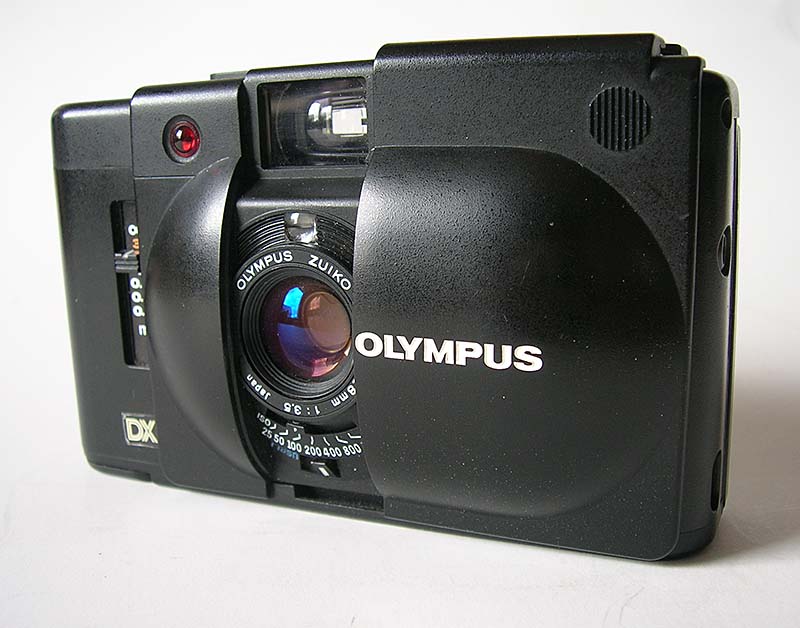
Olympus XA-4


All the advantages of the XA series combined with a 28mm lens. I found a nearly mint XA4, it even came with the measuring rope; the only drawback is a broken frame counter.
Edit: After exposing several films the counter came to life again and works since then!