The first six months of my exclusive use of the Rollei 35 are over, but I did not stop buying cameras.
Here is a first teaser for the things to come after August the 14th, 2011:
1)
Kodak Retina Ia with Schneider Xenar 3,5/50mm
I had a Retina with a Xenar 2,8 before, but it broke. Luckily I found this one on a flea market.
2)
Agfa Optima 1535 Sensor with Solitar 2,8/40mm
I had several models of the Agfa Optima Sensor series but a nice working rangefinder model is top of the list!
3)
Penti I with a brick of Orwo NP 20 SL cassettes
Agfa Rapid and Orwo SL are identical film systems and the Penti I with it´s unique film transport rod is a nice toy.
4)
Pentax Spotmatic SP II with Takumar 1,4/50mm
No need to say anything about this camera and lens, except the fact that some guy sold it to me for five Euro!
UPDATE: While playing with the Spotmatic, the aperture of the Takumar blocked:-(
5)
Nikon Af 600
A small and light P&S with 28mm lens
6)
Canon EOS 650 with Sigma 3,5-4,5/28-70mm
The worlds first AF-SLR, a big and heavy beast with a great handgrip and surface.
7)
Watameter rangefinder for the use with the Rollei 35 in the dark season
UPDATE: This doesn´t work for me! I used it a few times and found that it doesn´t match with my photographic style!
8)
Konica Big Mini
9)
Canon MC
10)
Sigma 28mm/2,8 in Nikon Ai mount
11)
Canon EOS 620 with 50mm/1,8 II (and Data Back)
Rollei 35 and Polypan F

There will be not much action for the next months, because I started a project called
"Rollei 35 and Polypan F".
The according blog is here: CLICK
The task is to shoot exclusively the Rollei 35 and the Polypan F for one year.
Exposing (50 ASA), developing (stand development in APH09 1+100) and scanning (Canoscan 8400F @ 3200 dpi)
shall be done under the same conditions for the whole year too.

Agfacolor CNS
I showed my son some of my old cameras and films, including a 126 cassette and a roll 120 of Agfacolor CNS. He asked me if it could still be developed.
I knew that there are some labs that still do C-22 for insane prices, but what I wanted to know was if it could be done at home.
What I found in the net was a manual for mixing the chemicals an advice to develop the film as a B&W (which I had done before, getting blank negatives) and some discussions about using C-41 chemistry. The advices were very academical and controvers. Some told to harden the film before developing, some said the temperature had to be hold low to avoid damage, some told to harden the film before blix, some said the blix of C-41 would loosen the emulsion.
To make this short: I put the film (120) onto the reel, filled in my expired developer at room temperature and let it stand for one hour - no agitation! I did the same with the blix. On the film, that I had bought with a Agfa Box, I found four frames, somewhat underexposed but visible. They hang to dry now, scans will follow tomorrow.
Summary at this point: Stand developing at room temperature in the C-41 process gives useable negatives from C-22 films.
The examples show the color aberrations that can be expected from a film that was stored in the camera for 20 years and then on my shelf for another 15 years, estimated time!


I knew that there are some labs that still do C-22 for insane prices, but what I wanted to know was if it could be done at home.
What I found in the net was a manual for mixing the chemicals an advice to develop the film as a B&W (which I had done before, getting blank negatives) and some discussions about using C-41 chemistry. The advices were very academical and controvers. Some told to harden the film before developing, some said the temperature had to be hold low to avoid damage, some told to harden the film before blix, some said the blix of C-41 would loosen the emulsion.
To make this short: I put the film (120) onto the reel, filled in my expired developer at room temperature and let it stand for one hour - no agitation! I did the same with the blix. On the film, that I had bought with a Agfa Box, I found four frames, somewhat underexposed but visible. They hang to dry now, scans will follow tomorrow.
Summary at this point: Stand developing at room temperature in the C-41 process gives useable negatives from C-22 films.
The examples show the color aberrations that can be expected from a film that was stored in the camera for 20 years and then on my shelf for another 15 years, estimated time!


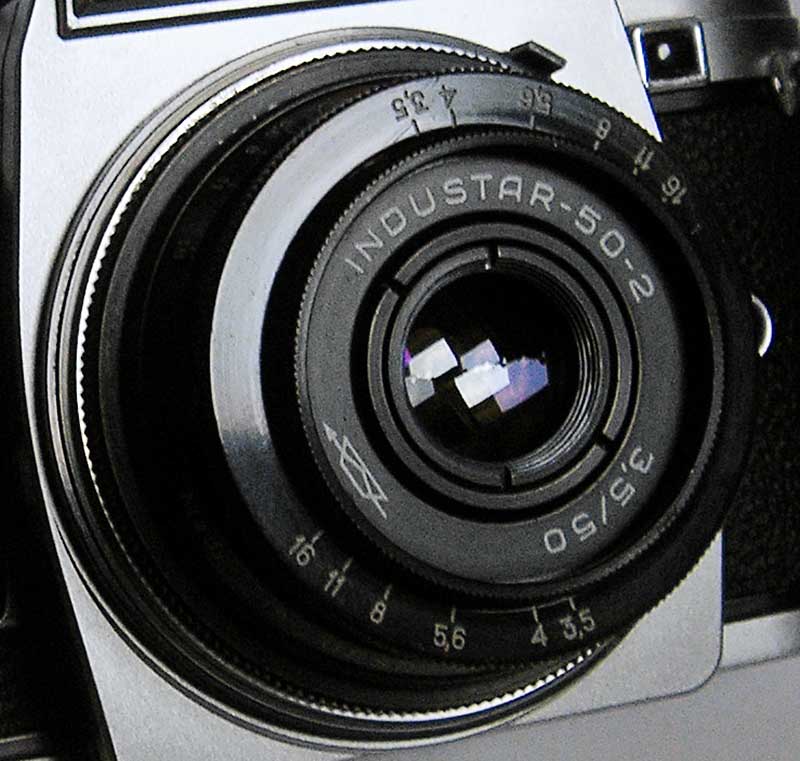
Nikon FG-20 and Industar-50-2
The lost cameras (III, Kodak EK 2)
Since the beginning of my relationship with photographic gear in 1979 I lost lots of equipment.
Some cameras died, some were sold, some I gave away as gifts. Luckily the photos survived.
You remember: Kodak once made Instant cameras and films too! Okay, only as long as Polaroid let them do so;-)
My first Instant camera was the Kodak EK2. See here:
It´s the model that didn´t have a motor to throw out the picture, no, you had do do this by winding a crank! When Kodak stopped producing instant films, Polaroid had a change-your-camera offer here in Germany and I gave away the EK2 and bought an Image (Spectra) instead. I still have some photographs from the EK2:


Some cameras died, some were sold, some I gave away as gifts. Luckily the photos survived.
You remember: Kodak once made Instant cameras and films too! Okay, only as long as Polaroid let them do so;-)
My first Instant camera was the Kodak EK2. See here:
It´s the model that didn´t have a motor to throw out the picture, no, you had do do this by winding a crank! When Kodak stopped producing instant films, Polaroid had a change-your-camera offer here in Germany and I gave away the EK2 and bought an Image (Spectra) instead. I still have some photographs from the EK2:


Use and abuse of a C41-kit


I started with a fresh mixed Tetenal C41 kit (1l).
After using it for some films in the standard 38 deg C/ rotation method,
I decided to try the developing at room temperature
(20 deg C).
Some searching in the web gave me a starting point at 15min with one agitation every 30 sec.
At 18 deg C I developed 30 min with identical agitation and found no difference in the negatives.
Blix time was 30 min, same agitation.
Then I changed to stand development at 20 deg C. First films were developed 60 min with ten initial agitations, then I reduced the developing time to 45 min. Blix time always one hour.
I developed in the kit 33 films so far. Whenever the developer went under 1l, I filled in water to get the litre again.
The scans came out in very different ways. Some pictures could be used without any correction, some had a strong red haze.
C-41 (VIII)
C-41 (VII)
The lost cameras (II, Polaroid 680 SLR)
Subscribe to:
Posts (Atom)